
Houston employers can use pre-employment physicals to evaluate whether a candidate is prepared for the defined physical requirements of a position. The most effective process starts with the job, not a one-size-fits-all examination.
Employers should identify the essential functions of the role, schedule the examination at the appropriate stage of hiring, provide the occupational health provider with clear job requirements, and use consistent criteria for candidates in the same job category. Depending on the position, the examination may include general physical assessment and job-specific functional, vision, hearing, respiratory, or other approved components.
Ford Occupational Health provides pre-employment, post-offer, post-employment, baseline, and employer-directed physical examinations for employers in Houston, Katy, West Houston, and surrounding Houston-area communities. Mobile availability is also offered by arrangement.
What is a pre-employment physical?
A pre-employment physical is an employer-directed examination used to assess a worker’s ability to perform defined job-related physical requirements. It may support onboarding for positions that involve lifting, carrying, climbing, prolonged standing, repetitive movement, use of personal protective equipment, or other physical demands.
The examination should be connected to the actual work. It is not intended to be a broad screening process unrelated to the position.
For example, a construction, manufacturing, warehouse, transportation, or skilled-trades position may require an employer to evaluate specific physical abilities before the employee begins work. A primarily administrative position may not require the same examination scope.
The employer should determine why an examination is needed and which components are relevant. The occupational health provider can then organize the evaluation around those requirements.
When may a physical be appropriate?
Pre-employment physicals may be appropriate when a position has documented physical requirements, safety-sensitive responsibilities, or workplace conditions that require an objective evaluation.
Common examples include positions that involve:
- Repeated lifting, carrying, pushing, or pulling
- Climbing ladders, stairs, scaffolding, or other structures
- Working from elevated platforms or uneven surfaces
- Prolonged standing, walking, kneeling, squatting, or reaching
- Repetitive or forceful movement
- Physically demanding work in construction, manufacturing, warehousing, or skilled trades
- Job-related vision or hearing requirements
- Respirator use or other defined respiratory protection requirements
- Specific physical standards established for the position
Employers should distinguish between a general hiring preference and an essential job function. A physical requirement should be based on the work the employee must perform, not on assumptions about age, appearance, general health, or a medical diagnosis.
Under guidance from the U.S. Equal Employment Opportunity Commission, employers generally may not require a medical examination before making a job offer. After a conditional offer, an employer may require a medical examination if it is required for all entering employees in the same job category.
Because requirements can vary by position and situation, employers should review hiring procedures with qualified legal or human resources professionals.
Define the job demands before scheduling
A clear job description improves the usefulness of the examination. It also helps the provider focus on the physical requirements that matter to the employer.
Before scheduling, HR, safety, or operations leaders should document:
Primary physical tasks
List the activities the employee will perform regularly. Examples may include lifting materials, moving equipment, operating controls, climbing, or working in specific body positions.
Weight and frequency requirements
Describe the approximate weight of items handled, how often they are handled, and whether the work involves lifting from the floor, waist, shoulder, or above the head.
Positional requirements
Identify expected periods of standing, walking, sitting, bending, kneeling, crouching, crawling, reaching, or working in confined positions.
Environmental conditions
Note relevant workplace conditions, such as outdoor work, uneven surfaces, temperature exposure, dust, noise, or the need to wear a respirator or other protective equipment.
Sensory requirements
Identify whether the position requires job-related visual acuity, color recognition, hearing ability, depth perception, or other sensory functions.
Essential functions
Separate essential job functions from duties that are occasional, incidental, or able to be reassigned. This distinction helps keep the examination focused.
The more specific the information, the easier it is to select an appropriate examination scope. A job description that only states “must be physically fit” provides limited direction. A description that identifies lifting, carrying, climbing, and positional requirements gives the provider a clearer basis for evaluation.

Avoid a one-size-fits-all examination
Different jobs create different physical demands. Applying the same examination to every employee may add unnecessary steps for some positions while failing to evaluate important requirements for others.
A more structured approach is to define examination packages by job category. For example:
- Office or administrative roles: A focused examination may be appropriate only when the position includes defined physical requirements.
- Warehouse and logistics roles: The scope may address lifting, carrying, mobility, repetitive movement, and positional tolerance.
- Construction and skilled-trades roles: The employer may need to address climbing, balance, strength, endurance, and work-related movement.
- Manufacturing roles: The examination may reflect standing, repetitive tasks, equipment interaction, and specific sensory requirements.
- Transportation roles: A DOT physical may apply when the position is subject to Federal Motor Carrier Safety Administration requirements. Other non-DOT positions may require a separate employer-directed examination based on the actual job.
- Respirator-required positions: Respirator medical clearance and fit testing may be coordinated when appropriate for the job and available through the employer’s defined program.
Ford Occupational Health can help employers organize employment physicals around job demands and workforce readiness. Approved job-specific components may include functional, vision, hearing, respiratory, or other appropriate elements.
The purpose is to create a defined process that is relevant to each job category. This may help reduce unnecessary scheduling, avoid incomplete evaluations, and provide employers with documentation aligned with the position.
Consider functional ability evaluations for demanding roles
A general physical examination may not fully address a position that requires specific lifting, carrying, mobility, or positional abilities.
A functional ability evaluation can assess job-related abilities such as:
- Lifting and carrying
- Pushing and pulling
- Bending, kneeling, squatting, and reaching
- Walking and standing tolerance
- Climbing and mobility
- Position-specific movement
- Other defined physical tasks
The evaluation should reflect the actual requirements of the job. Employers should provide accurate information about the work, including the tasks performed, expected loads, frequency, and required positions.
Functional ability evaluations are not a substitute for a well-defined job description. They are most useful when the employer and provider agree in advance on what needs to be assessed.
What employers should provide before the appointment
A complete referral helps the examination move forward without avoidable delays. Employers should provide the occupational health provider with:
- The job title and job category
- A current job description
- Essential physical functions
- Lifting, carrying, pushing, and pulling requirements
- Position, mobility, and endurance expectations
- Relevant workplace or environmental conditions
- Required forms and documentation
- The examination components requested
- The appropriate hiring stage for the examination
- An authorized employer contact for questions
The candidate should also receive clear scheduling instructions. These instructions may include the appointment location, identification requirements, expected duration, forms to complete, and any preparation information provided by the occupational health provider.
A defined process is particularly important for employers hiring multiple workers for the same role. Standardized instructions can help HR and staffing teams coordinate appointments and track completion.
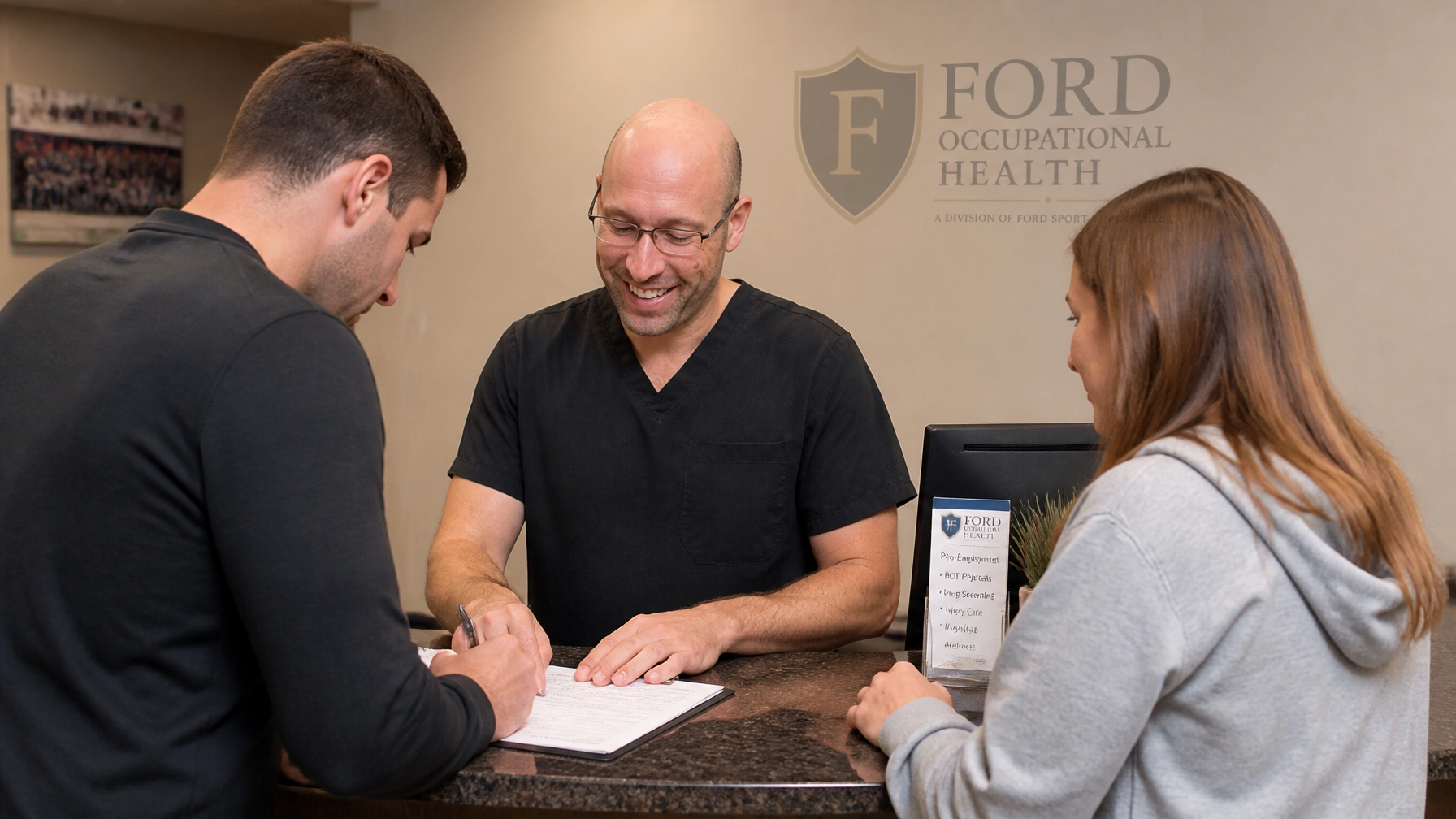
How physicals can support onboarding
Pre-employment physicals may support a more organized onboarding process when they are included in the hiring workflow at the right stage.
Employers can establish:
- A standard referral process for each job category
- A list of approved examination components
- Consistent forms and job descriptions
- A central scheduling contact
- Defined documentation requirements
- A process for addressing incomplete information
- A confidential method for receiving appropriate fitness documentation
Ford Occupational Health describes this process as define, examine, and communicate. First, the employer defines the position and examination requirements. Next, the candidate completes the approved medical and functional components. Finally, appropriate documentation is communicated to the employer while maintaining confidentiality.
Medical information should be handled separately from ordinary personnel records and limited to individuals with a legitimate business need to know. Employers should work with their legal and HR advisers to establish procedures for confidentiality, accommodations, and the use of examination results.
Options for Houston-area employers
Employers in Houston, Katy, West Houston, and surrounding communities may need examinations for individual new hires, recurring hiring programs, multiple job categories, or time-sensitive workforce onboarding.
Depending on the employer’s requirements, services may be coordinated through a clinic-based process or through mobile occupational health services by arrangement. Mobile availability may be useful for organizations with larger groups of employees, limited travel flexibility, or a need to coordinate services at a worksite.
The appropriate option depends on the number of workers, job locations, examination scope, scheduling requirements, and documentation process.
Employer checklist
Before implementing or revising a pre-employment physical process, confirm that:
- The examination is connected to defined job requirements.
- The examination occurs at the appropriate stage of the hiring process.
- Candidates in the same job category are handled consistently.
- The job description reflects current duties.
- Examination components are limited to relevant requirements.
- The provider receives complete job-demand information.
- Functional testing is used when the position requires specific physical abilities.
- Medical information is handled confidentially.
- Employer forms and reporting expectations are defined.
- Scheduling and follow-up responsibilities are clear.
Pre-employment physicals may help Houston employers evaluate readiness for specific work requirements and support a more coordinated onboarding process. The examination should be practical, job-related, and structured around the position rather than applied as a broad screening tool.
Ford Occupational Health supports employers with occupational health services designed around workforce requirements, scheduling, documentation, and operational needs. To discuss a position or hiring program, request employer services and provide information about the job requirements, examination scope, scheduling needs, and whether clinic or mobile options should be considered.
Pingback: Fit-for-Duty vs. Return-to-Work Exams | FOH