
Employer question: When should an employer request a fit-for-duty evaluation, and when is a return-to-work evaluation more appropriate?
The terms are sometimes used interchangeably. They address related workforce questions, but they are not identical. The main difference is the employer’s reason for the referral.
A fit-for-duty evaluation addresses whether an employee can safely perform the essential functions of a defined job. A return-to-work evaluation addresses readiness to resume work following an injury, illness, treatment, or medically related absence.
Both evaluations are employer-directed, job-related, and referral-driven. The quality of the result depends on how clearly the employer defines the job, the reason for the evaluation, and the specific question that needs to be answered.
Fit-for-duty evaluations address current job capability
A fit-for-duty evaluation is generally used when an employer needs objective information about an employee’s ability to perform a particular job safely.
The referral may relate to:
- A safety-sensitive position
- A documented change in job performance or function
- A post-condition or post-treatment question
- A specific concern about essential job duties
- A job change involving different physical or functional demands
- The need to clarify work restrictions or capabilities
The evaluation is focused on the defined position. It is not a general review of the employee’s overall health.
Ford Occupational Health’s fit-for-duty evaluations are designed to consider the employer’s referral question, essential job demands, relevant findings, and focused work-capacity information within the authorized scope of the evaluation.
The evaluation may help clarify whether the employee is:
- Able to perform the essential functions of the job
- Able to work with defined restrictions
- In need of additional functional information
- Unable to safely perform the identified duties at the time of evaluation
The evaluation provides job-related medical information. It does not guarantee employment eligibility, regulatory compliance, or a particular employment outcome.
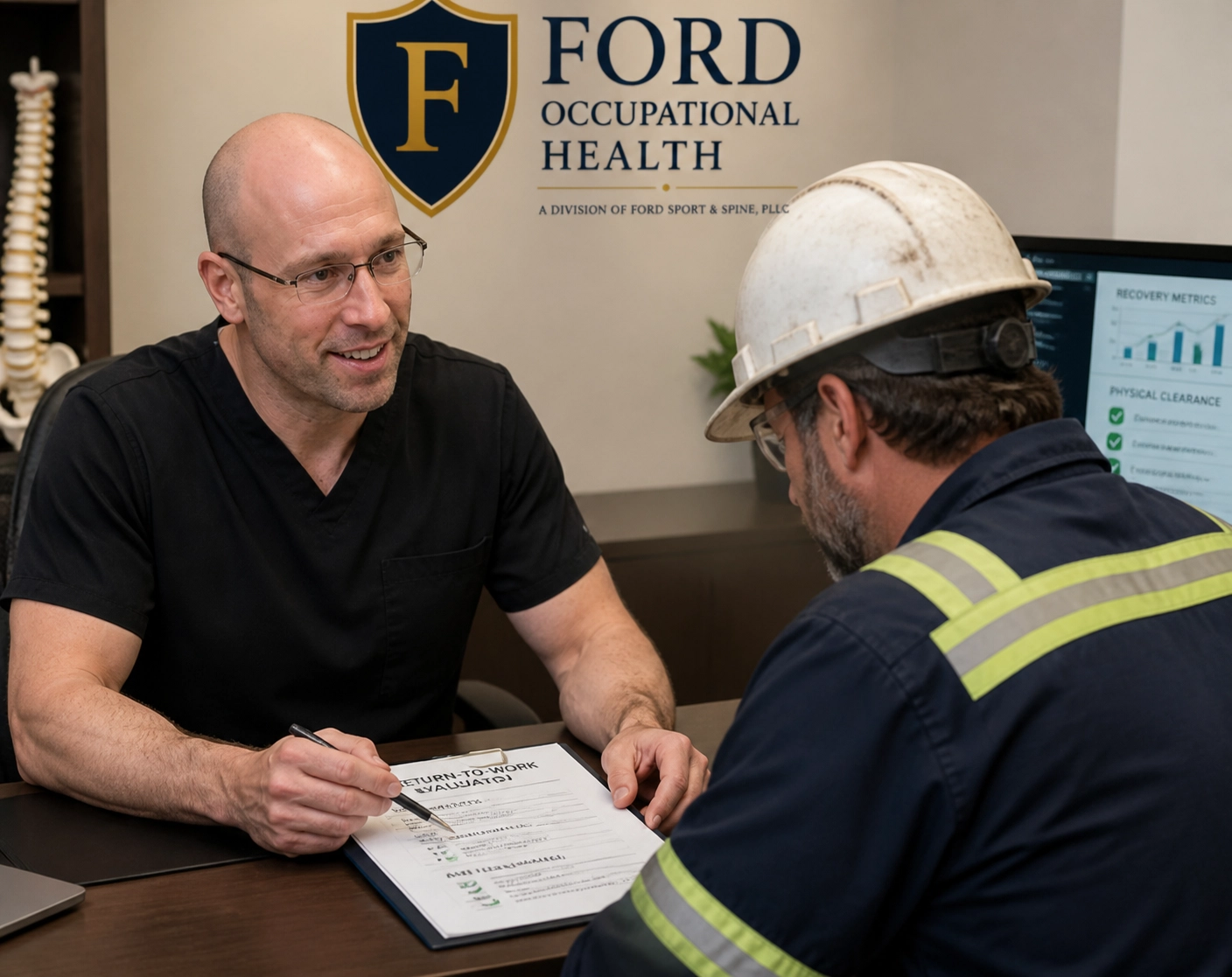
Return-to-work evaluations address readiness after an absence
A return-to-work evaluation is typically used when an employee is expected to resume work after an injury, illness, treatment, or other medically related absence.
The employer may need to understand:
- Whether the employee can resume the defined job
- Whether restrictions affect essential duties
- Whether a staged or modified work process should be considered
- Whether additional functional information is needed
- Whether the current job demands match the employee’s present abilities
The evaluation should be tied to the work being considered. A statement such as “cleared to return to work” may not provide enough information for a position that involves lifting, climbing, driving, operating equipment, prolonged standing, or other specific demands.
Ford Occupational Health provides return-to-work evaluations using employer-provided job information and a defined referral question. Communication is limited to the authorized scope of the evaluation and appropriate medical privacy standards.
A return-to-work evaluation often follows a medical absence. A fit-for-duty evaluation may be used when the employer has a separate, specific question about an employee’s ability to perform a job safely. In some situations, the two processes may overlap or occur in sequence.
Fit-for-duty and return-to-work evaluations compared
| Consideration | Fit-for-duty evaluation | Return-to-work evaluation |
|---|---|---|
| Primary question | Can the employee safely perform the essential functions of a defined job? | Is the employee ready to resume work following an injury, illness, treatment, or absence? |
| Typical timing | During employment when a defined job-related question arises | Before or during an employee’s return after a medically related absence |
| Referral focus | Job capability, safety, performance, or a specific condition-related concern | Work readiness, restrictions, and ability to resume identified duties |
| Information needed | Job description, essential functions, physical demands, referral reason | Job description, absence or treatment context, current restrictions, return-to-work question |
| Possible related service | Functional ability evaluations when physical capacity needs to be examined | Functional ability evaluations when restrictions or tolerance need further clarification |
Both services should remain focused on the job. Neither should be treated as a broad request for unrelated medical information.
These evaluations are different from physicals and DOT examinations
Employers should distinguish among several types of occupational health services.
Pre-employment and employment physicals
A pre-employment or employment physical is generally connected to hiring, placement, or an established employment process. It may be used to evaluate whether a worker is medically and functionally prepared for the requirements of a position.
This is different from an evaluation of a current employee returning after an absence or being assessed because of a specific job-related concern. Employers can also review pre-employment physicals for Houston workforces for additional context.
DOT physical examinations
A DOT physical examination is a separate service with its own purpose, requirements, and documentation. It is associated with applicable commercial driver medical qualification processes.
A DOT physical should not automatically be substituted for a fit-for-duty evaluation or return-to-work evaluation. Employers with commercial drivers should define whether the need involves a DOT examination, a separate employer-directed evaluation, or both. Additional background is available in this guide to DOT physical examinations for Houston drivers and employers.
Functional ability evaluations
A functional ability evaluation is a separate service focused on physical abilities relevant to defined work demands. Depending on the referral, this may include lifting, carrying, mobility, positional tolerance, and other job-related activities.
Functional ability evaluations may be appropriate when the employer needs more specific information about physical performance than a standard physical examination provides.
A physical, a DOT examination, and a functional assessment are not interchangeable. Each serves a different purpose and produces different types of information.
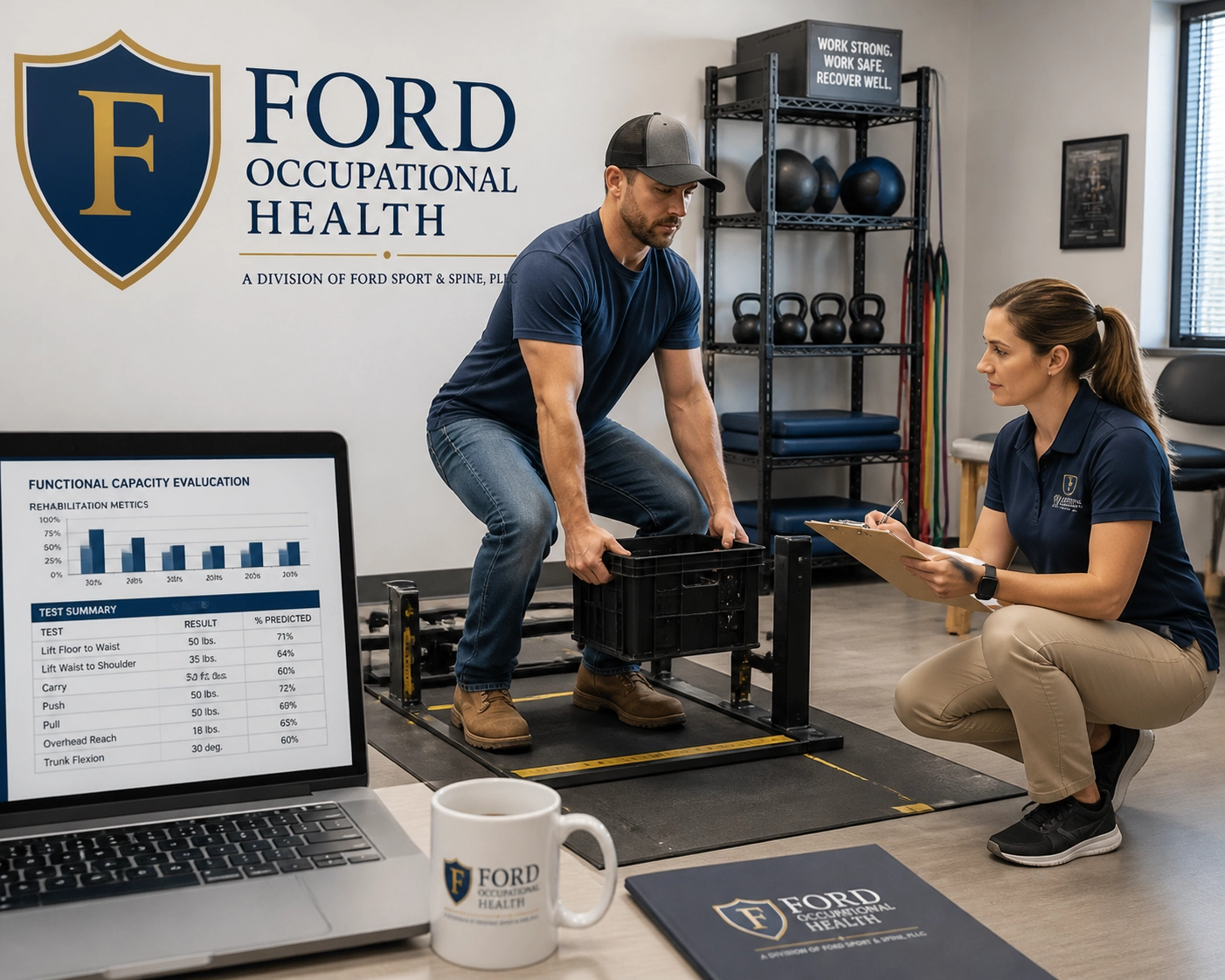
What employers should provide with a referral
A clear referral helps keep the evaluation focused and reduces follow-up delays.
Employers should generally provide:
- Employee name and authorized contact information
- Job title and current work status
- A current job description
- Essential job functions
- Physical demands, such as lifting, carrying, climbing, standing, walking, or equipment operation
- Relevant work-environment information
- The reason for the referral
- Available restrictions or work-status documentation
- Relevant forms or employer policies
- Specific questions the evaluation should address
- The requested timeframe and return-to-work date, when applicable
The referral question should be specific. For example:
- Can the employee perform the essential lifting and carrying requirements of this position?
- Can the employee safely resume the identified job duties?
- Are the current restrictions consistent with the physical demands of the position?
- Is additional functional testing needed to clarify work capacity?
Employers should avoid sending unrelated medical records or requesting information that is not needed to evaluate the defined job question.
ADA and employer decision-making
The U.S. Equal Employment Opportunity Commission states that, after employment begins, disability-related inquiries and medical examinations generally must be job-related and consistent with business necessity. The scope should generally be limited to information needed to assess the employee’s ability to perform essential job functions or address a legitimate safety concern.
The EEOC also explains that an employer’s belief should be based on objective evidence rather than general assumptions. Its guidance addresses disability-related inquiries and medical examinations in the workplace, including situations involving an employee returning from leave. Employers can review the EEOC guidance on disability-related inquiries and medical examinations of employees.
For work-related injuries, the EEOC explains that questions and examinations should remain related to the specific injury and its effect on the employee’s ability to perform essential job functions. Employers can review the EEOC guidance on workers’ compensation and the ADA.
These resources are general guidance and do not replace legal advice. Employers should consult qualified legal or HR professionals when developing policies, evaluating accommodation issues, or coordinating ADA, leave, workers’ compensation, and other applicable requirements.
Employer checklist before scheduling
Use this checklist to prepare a more efficient referral:
- Define the job: Identify the position and its essential functions.
- Define the question: State whether the concern involves return readiness, current job capability, restrictions, or functional capacity.
- Confirm the service: Determine whether the need is a fit-for-duty evaluation, return-to-work evaluation, functional ability evaluation, employment physical, or DOT physical examination.
- Document the reason: Record the objective, job-related reason for the referral.
- Provide accurate demands: Include lifting limits, postural requirements, equipment use, driving, exposure, and other relevant duties.
- Limit the scope: Request only information related to the defined job question.
- Identify the decision-maker: Provide the authorized employer contact for communication and documentation.
- Coordinate next steps: Establish how restrictions, additional testing, or follow-up information will be reviewed.
Employers may also coordinate related services through mobile/on-site occupational health services when multiple employees, scheduling limitations, or worksite logistics make on-site delivery practical.

Common employer questions
Is a return-to-work evaluation the same as a fit-for-duty evaluation?
No. A return-to-work evaluation focuses on readiness to resume work after an absence. A fit-for-duty evaluation focuses on whether an employee can safely perform the essential functions of a defined job. The services may overlap depending on the referral question.
Can an employer use a pre-employment physical for a returning employee?
Not automatically. A pre-employment or employment physical serves a different purpose. The appropriate service depends on the employee’s status, the employer’s policy, the job requirements, and the question that needs to be answered.
Does a fit-for-duty evaluation determine whether an employee keeps a job?
No. The evaluation provides focused medical and functional information. The employer makes employment decisions based on the evaluation, job requirements, applicable policies, and guidance from qualified HR or legal professionals.
When might functional ability testing be useful?
Functional ability testing may be useful when the employer needs specific information about lifting, carrying, mobility, positional tolerance, or other physical demands that are not fully addressed by a general physical examination.
Support for Houston-area employers
Employers in Greater Houston, Katy, West Houston, and surrounding Houston-area communities often manage physically demanding or safety-sensitive roles. These include transportation and logistics, construction and infrastructure, staffing, oil and gas, industrial operations, manufacturing, warehousing and distribution, skilled trades, and government or public-sector workforces.
For these employers, a defined referral process can support clearer documentation, better scheduling, and more consistent workforce decisions.
Ford Occupational Health provides fit-for-duty evaluations, return-to-work evaluations, functional ability evaluations, employment physicals, DOT physical examinations, and other approved occupational health services for employer-directed needs. Employers can review the full range of occupational health services or use the employer portal for referral resources.
To discuss a specific employee question, job demand, worksite, or scheduling requirement, contact Ford Occupational Health. The next step can begin with defining the position, the reason for referral, and the information the employer needs.